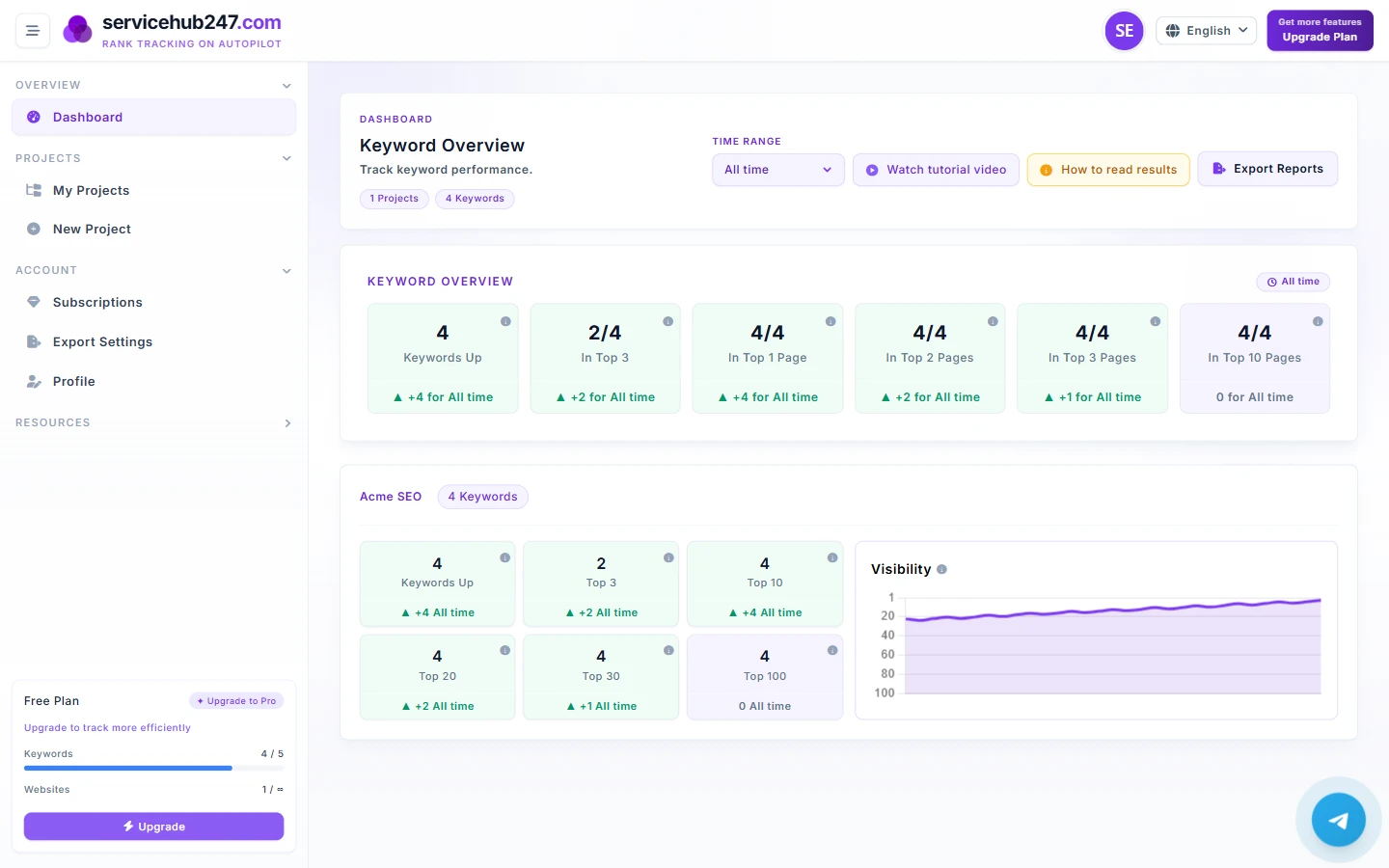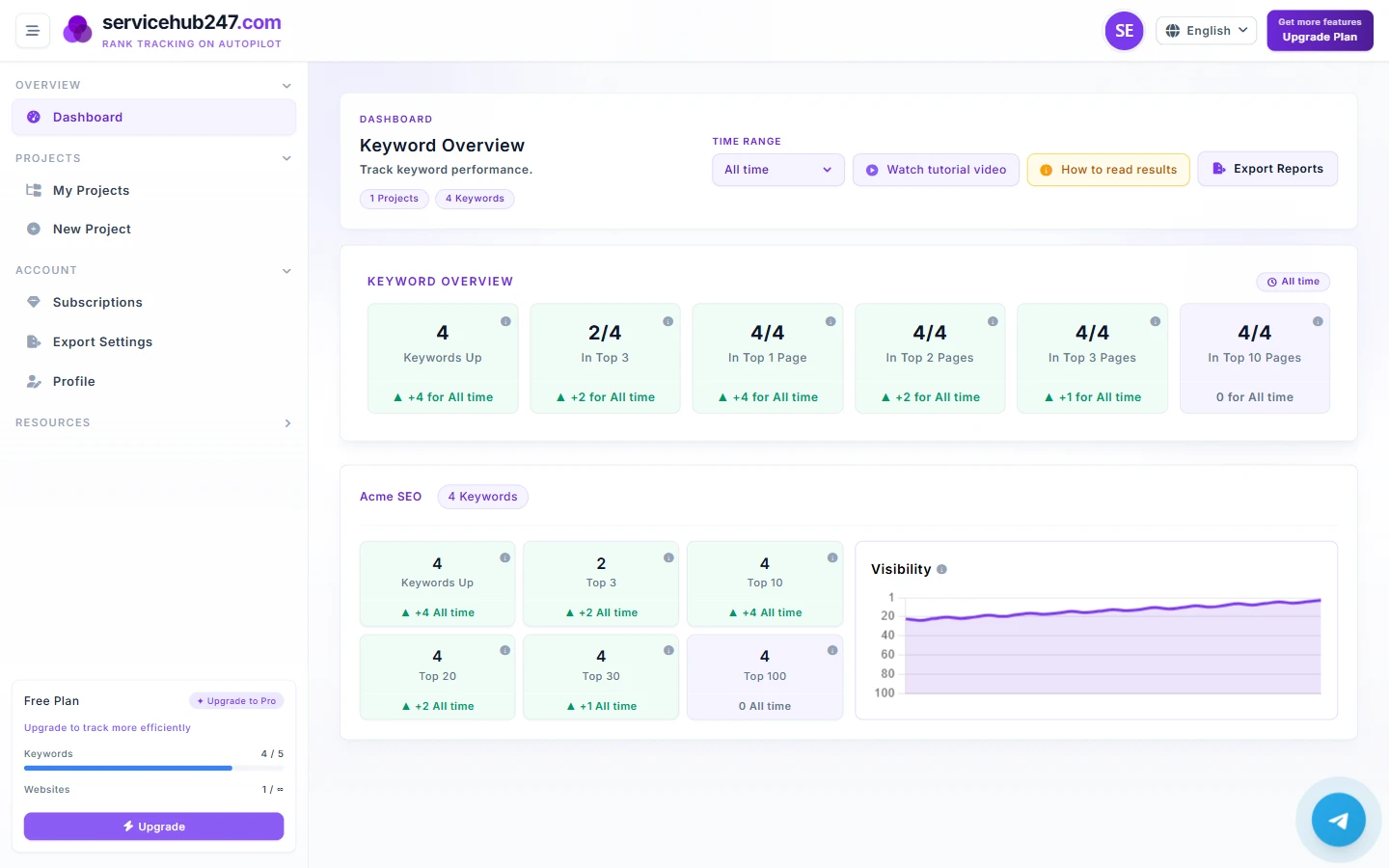
A very common situation: you open Servicehub247 at 3:16 PM and the keyword "keyword rank checker" shows No ranking. But when you search that exact term on Google yourself, your website shows up on page 4. Twenty minutes later you check the tool again and the keyword now reads page 4, position 37, status Top 10. So is the tool wrong? No. This is normal behaviour for every rank-tracking tool, and here is exactly why.
Every check is a "snapshot" at a single moment
Servicehub247 doesn't ask Google "what position is this page?". It actually runs a neutral search at the moment of the crawl, then looks for your domain in the results it gets back. That result is a snapshot of the search page at that exact second.
The catch is that Google results don't sit still. For the same keyword, Google can return a slightly different order between two checks minutes apart - because of index updates, display experiments, or shifting search volume. So a snapshot at 3:16 and a snapshot at 3:36 being different is completely natural.
Why searching Google yourself usually looks better
When you type a keyword in your own browser, Google personalises the results based on:
- Your location (Google favours nearby sites).
- Your search history and the pages you've clicked before.
- The account you're signed into and the device you're using.
If you visit that website often, or you're in the same area as the business, Google pushes it higher for you specifically. The tracker deliberately strips all of that out to measure objectively. That's why "I searched and saw it on page 2" and "the tool says page 4" can both be true - they're just two different viewpoints.
"No ranking" doesn't mean your site isn't ranking
The No ranking label only means: at that particular crawl, the tool didn't find your domain within the range it checked. There are a few reasons this happens even when the site really does rank:
- At the moment of the crawl, the site fell outside the tracked range (results dipped lower).
- The keyword was just added and the first crawl ran before data was fully available.
- Google returned a different result variant at that exact second.
In other words, "No ranking" is the outcome of one measurement, not a verdict on the whole website. The next crawl picking up a position is normal - exactly like the case at the start, where 20 minutes later it showed page 4, position 37.
So can you trust the tool?
Yes. It's because the tool measures honestly and objectively that its numbers are sometimes more modest than what you see yourself - not because it's "less accurate". A tool that always reports flattering rankings is the one to worry about, because it's pleasing the viewer instead of reflecting the real Google.
The strength of automated tracking is that it measures consistently, the same way, over a long period - something manual searching can't do. When you search Google by hand it's a different way each time, a different moment, a different logged-in state, so you can't compare one day to the next. The tool gives you a consistent trend line telling you whether rankings are rising or falling. That's what drives SEO decisions - not the number from a single random search.
Why two checks 10–20 minutes apart differ
Pulling the causes above together, here's why two nearby checks can disagree:
| Cause | What's happening |
|---|---|
| Google genuinely fluctuates | The results page reorders between moments - nothing is fixed during the day. |
| First crawl had no data yet | A new keyword needs a few minutes for a complete first measurement. |
| Result variants | Google tests different arrangements for the same query. |
| Measurement region / device | The tool measures neutrally, unlike your personalised manual search. |
New keywords need 5–10 minutes for first data
The moment you add a keyword, the table may show empty or "No ranking" for the first few minutes. That's the system running its first crawl. The table updates automatically - no need to reload. After 5–10 minutes the first data lands, and the system keeps crawling on a cycle to build the ranking history.
How to read the data correctly
A rank tracker exists to show the trend over time, not to lock in an absolute number at a single second. Because Google has daily noise, one isolated measurement says little. The right way to read it:
- Judge by the trend line over days to weeks, not a single crawl.
- Watch whether the site is rising or falling over time - that matters more than "what exact number is it today".
- When you see a surprising number, wait one or two more crawls before concluding.
- Treat the tool's number as a relative, objective gauge for monitoring - your own manual search will look better because it's personalised.
Quick summary
- Every check is a neutral snapshot at that moment; Google fluctuates, so two nearby checks can differ.
- Searching Google yourself usually looks better because it's personalised to your location, history, and account.
- "No ranking" is the result of one measurement, not proof the site doesn't rank.
- New keywords need 5–10 minutes for first data; the table updates itself, no reload needed.
- Read the trend over time - don't judge by a single isolated crawl.